So what is BGP? Border Gateway Protocol Explained (2026)
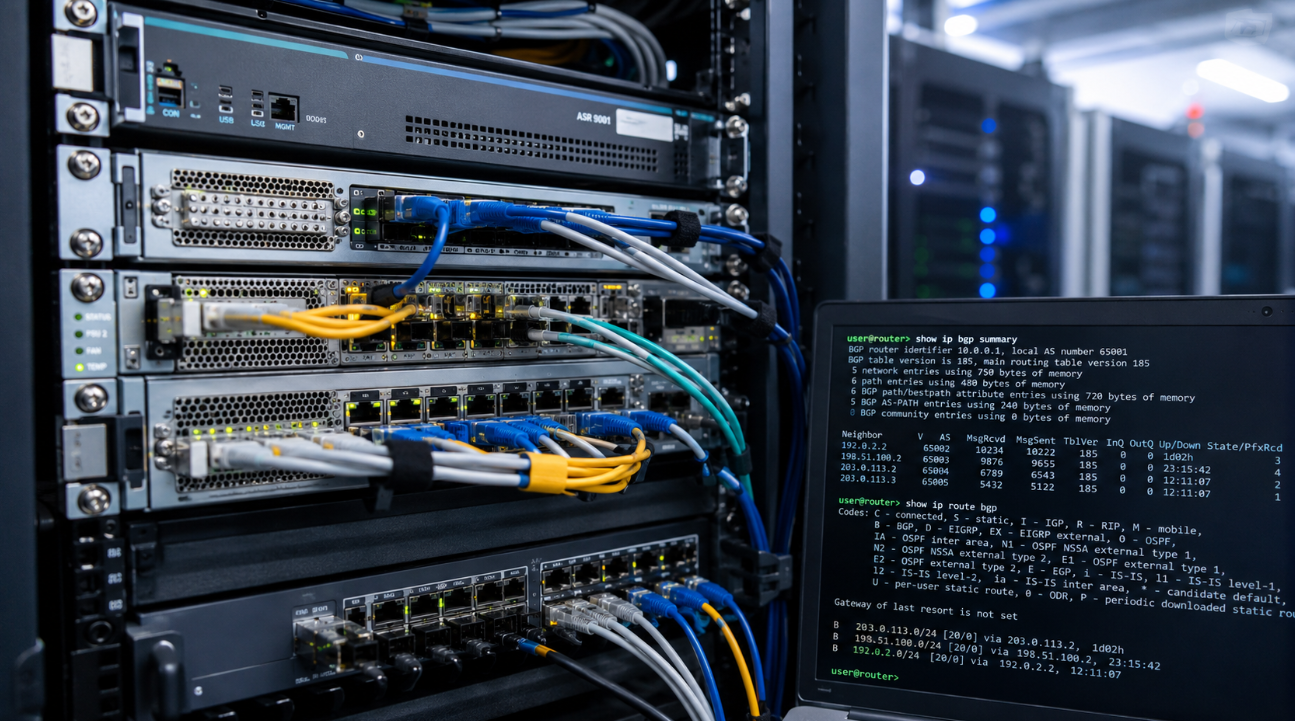
So what is BGP?
BGP stands for Border Gateway Protocol. In plain terms, it’s the standardised system the internet uses to exchange routing and reachability information between large networks. That’s the textbook definition, and it really is the heart of it, so let’s unpack it.
The internet isn’t a single network. It’s tens of thousands of separate networks stitched together: internet service providers, cloud platforms, mobile carriers, universities and big companies. Each of these is called an autonomous system, and each has its own number, an ASN, a little like a telephone area code.
BGP is the common language those networks use to talk to one another. Each one announces, in effect, “here are the ranges of internet addresses I can deliver traffic to,” and BGP gathers up all of those announcements so that any network can work out a path to any other. Without it, the separate pieces of the internet would have no agreed way to find each other.
The internet’s road signs
A helpful way to picture BGP is as the road signs and sorting office of the internet, rather than the vehicles or the roads themselves.
BGP doesn’t carry your data. It works out the route that data should take. Every network advertises which destinations it can reach and which neighbours it connects to. Routers then compare the available paths and choose the one that looks best, usually the one that crosses the fewest networks to get there.
Because every route carries a record of the networks it passes through, the system can avoid sending traffic round in circles, and each network gets to apply its own preferences about which way to send things. It’s updating constantly, too. If a link goes down somewhere, BGP notices that a route has disappeared and the rest of the internet quietly reroutes around the gap, often before anyone notices.
Why this matters if you run a business
You’ll almost certainly never configure BGP yourself. That job sits with your internet provider and your hosting or cloud platforms. But BGP underpins nearly everything your business relies on online: your website being reachable, your email arriving, your cloud software loading, your card payments going through.
The reason it’s worth knowing the name is that when BGP goes wrong, it tends to go wrong in a big, visible way. A few well-known examples make the point.
The day Facebook vanished
In October 2021, Facebook, Instagram and WhatsApp disappeared from the internet for around six hours. Nothing had been hacked. A faulty internal change withdrew the BGP routes that told the rest of the world where to find Facebook’s systems. The servers were still running; the directions to them had simply been erased, and for a while billions of people couldn’t load the sites at all. It rhymes with the internet’s address-book failures, where the names stop resolving instead.
Traffic sent the wrong way
Because networks largely take each other’s BGP announcements on trust, it’s possible for one to claim, by mistake or on purpose, that it can reach addresses it has no business handling. The result is a route leak or a BGP hijack: traffic meant for one place gets pulled somewhere else, causing outages or, in the worst case, giving someone the chance to snoop on it. It has happened to banks, payment networks and large online services.
The “512k day”
Back in 2014, the global list of internet routes grew past a limit that a lot of older routers had been set up to hold, around 512,000 entries. Hardware around the world started misbehaving on the same day, and chunks of the internet slowed or dropped out. It was a useful reminder that even the internet’s plumbing has finite limits that have to be managed.
BGP is one of those foundations you only ever meet on the day it fails. The rest of the time, it works silently, which is exactly why so few people have heard of it.
The practical takeaway: stay reachable
For most small and growing businesses, the lesson isn’t to go and learn BGP. It’s to make sure your business isn’t sitting on a single weak link. A few sensible habits cover most of it:
- Choose well-connected providers. Good hosting and cloud platforms reach the internet through several networks at once, so if one path has a bad day your services stay reachable through another. That’s the resilient version of what BGP makes possible.
- Have a fallback for your own connection. A second line or a mobile failover means one provider’s outage doesn’t take your whole office offline with it.
- Keep an eye on your systems. Monitoring that tells you something has become unreachable, ideally before your customers find out, turns a quiet crisis into a quick phone call.
A word on security
BGP was designed decades ago, in a more trusting era, and it largely assumes networks are telling the truth about which addresses they can reach. That assumption is exactly what makes hijacks possible.
The wider industry has been steadily fixing this with measures that let networks verify whether a route really is coming from its rightful owner. You don’t need to implement any of that yourself. It’s simply one more reason to choose infrastructure providers who take it seriously, and to treat the security of your connectivity as part of the picture rather than an afterthought.
The short version
BGP is the set of directions that lets the internet’s thousands of separate networks find one another, so your data reaches the right place. You’ll never touch it. But the providers you build on either look after it well, with good connections and sensible security, or they don’t, and that difference tends to show up on the day something breaks.
The bottom line
Almost all of the time, BGP works flawlessly and invisibly. When it does break it’s dramatic, and it’s usually entirely out of your hands. What is in your hands is what you choose to build on. Solid, well-connected hosting, a connection with a fallback, and a bit of monitoring all mean the rare bad day out on the wider internet is far less likely to become a bad day for your customers.
If you’d like a straightforward look at how resilient your connectivity and hosting actually are, with no jargon and no pressure, that’s exactly the kind of conversation we enjoy having.